
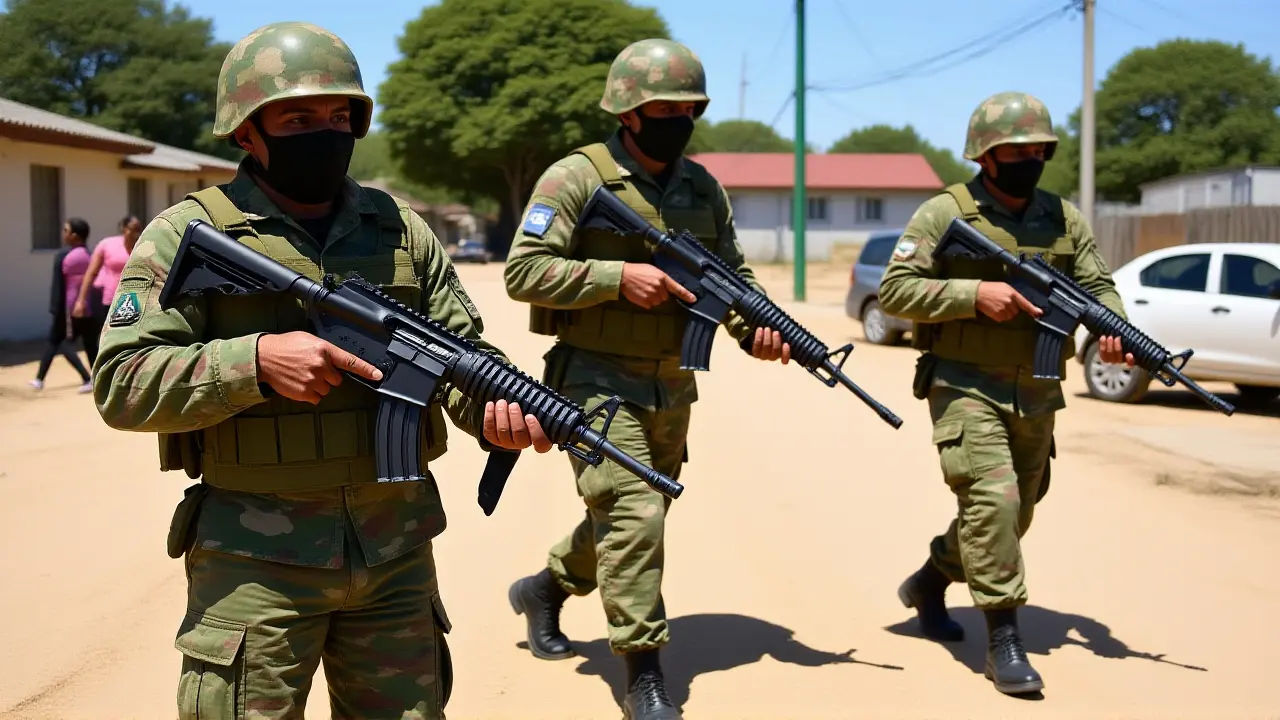
In a move that signals a growing desperation to regain control of the streets, Cyril Ramaphosa, President of South Africa has authorized the deployment of 2,200 soldiers to battle a surge in organized crime. Starting April 1, 2026, and running through March 31, 2027, the military will flood five provinces to tackle the dual plagues of gang warfare and illegal mining. It's a high-stakes gamble designed to provide the muscle the police simply haven't had.
Here's the thing: this isn't just a routine patrol. This is Operation Prosper, a 13-month commitment that marks the longest military intervention in domestic law enforcement in recent memory. The scale is massive, covering the economic heart of Gauteng, the tourism-heavy Western Cape, and the North West, Free State, and Eastern Cape provinces. The cost? A staggering $49.2 million (USD) that some are calling a necessary evil, while others see it as a costly band-aid.
- Force Size: 2,200 South African National Defence Force (SANDF) members.
- Duration: 13 months (April 1, 2026 – March 31, 2027).
- Budget: $49.2 million USD.
- Primary Targets: Illegal mining syndicates and gang violence.
- Control: Soldiers operate under police command authority.
A Desperate Strategy for a Public Safety Crisis
The announcement came during the President's 10th State of the Nation Address in Cape Town, where the mood was heavy with the reality of South Africa's crime statistics. Brigadier-General Martin Gopane, the Director of Operations for the SANDF, didn't mince words: the objective is to slash violent crime. But the reality on the ground is far more complicated than a military order.
Turns out, the police are the ones holding the leash. While the soldiers provide the numbers, the police maintain command authority. They've set four clear goals: shrinking crime in "hot spots," arresting the ringleaders, sweeping up illegal firearms and explosives, and seizing narcotics. It sounds straightforward on paper, but in the narrow alleys of the Cape Flats, the rules of engagement are rarely simple.
The focus on illegal mining is particularly telling. These aren't just lone scavengers; we're talking about sophisticated criminal syndicates that operate like corporations, often with more firepower than the local precincts. By deploying the army, the government is admitting that the police are outgunned.
The Bloody Reality: Early Failures in the Western Cape
But wait—has the deployment actually worked? The early numbers are devastating. Just two weeks into the operation, the violence didn't slow down; it seemed to intensify. Roughly 50 people were killed in that short window. Most heartbreakingly, the crossfire is claiming the youngest among us. In the Western Cape alone, over 40 shootings occurred in those fourteen days, leaving three children dead and nine others wounded.
It's a grim paradox. In Johannesburg, some residents were reportedly cheering as soldiers marched into their neighborhoods, desperate for any sign of authority. Yet, in the shadows of those same streets, the killing continues. This disconnect suggests that while the presence of uniforms might offer a psychological sense of security, the root causes of the gang wars—poverty, unemployment, and systemic neglect—can't be solved by a rifle.
Comparing the Military Push: 2023 vs. 2026
This isn't the first time the state has tried this. Back in 2023, President Ramaphosa deployed over 3,000 soldiers, but only for a single month. That was a "shock and awe" tactic—a quick burst of force to disrupt criminal patterns. This new 13-month stretch under Operation ProsperSouth Africa is different. It's a marathon, not a sprint.
Opposition parties have raised eyebrows at the $49.2 million price tag. They argue that the money could be better spent on intelligence-led policing or upgrading the judicial system. However, for a mother in the Cape Flats who fears for her children every time they walk to school, a budget debate feels secondary to the immediate need for a soldier on the corner.
The Long-Term Outlook and Human Cost
What's next? The government is betting that a prolonged military presence will break the back of the syndicates. But history suggests that when the army leaves, the vacuum is often filled by the same gangs, sometimes more aggressive than before. The real test will be whether the police can use this military cover to make permanent arrests and dismantle the financial networks that fuel the illegal mining trade.
Oddly enough, the deployment might actually highlight the fragility of the police force. If the state needs the army to perform basic law enforcement for over a year, it's a tacit admission that the national police service is in a state of collapse. The ripple effects will be felt in the courts, which are already overburdened, as thousands of new arrests flood the system.
Frequently Asked Questions
What is the primary goal of Operation Prosper?
Operation Prosper is specifically designed to combat organized crime, focusing heavily on two areas: the violent gang wars that plague poor neighborhoods and the sophisticated illegal mining operations run by criminal syndicates. The goal is to reduce overall violent crime and recover illegal weapons and drugs.
Who is in charge of the soldiers during this deployment?
Although the troops are members of the South African National Defence Force (SANDF), they are not operating independently. The South African Police Service (SAPS) maintains command authority, meaning the soldiers are essentially providing tactical support and manpower for police-led law enforcement operations.
Why is the Western Cape seeing so much violence despite the troops?
The Western Cape, particularly the Cape Flats, has deep-seated gang structures that are highly resilient. Initial reports show that the arrival of troops didn't immediately stop the violence; in the first two weeks, 50 people died. This suggests that gangs may be shifting their tactics or escalating conflicts to maintain control despite the military presence.
How does this deployment differ from the 2023 military action?
The 2023 deployment was a short-term intervention involving more than 3,000 soldiers for just one month. In contrast, the 2026 deployment is a long-term strategic commitment of 2,200 soldiers for 13 months, reflecting a shift from temporary "crackdowns" to a sustained effort to reclaim high-crime zones.
What is the financial impact of this operation?
The operation is estimated to cost $49.2 million (USD). This expenditure has become a point of contention among opposition political parties, who question whether these funds would be more effective if invested in long-term police training and judicial reform rather than short-term military deployment.



Gary Clement
military support for police is common in fragile states but the command structure is where it usually fails
if the police are already compromised by corruption then the soldiers are just following orders from the same people enabling the gangs
Josh Raine
This is just a systemic failure of the social contract! 🙄 Why do we keep pretending that putting boots on the ground solves poverty? It is a superficial response to a deep ontological crisis of governance and a total lack of socio-economic infrastructure. The state is just trying to perform authority without actually possessing the legitimacy to govern the marginalized sectors of society. It is absolutely disgusting to spend millions on soldiers while children are literally dying in the crossfire. We are seeing the commodification of security where only those in "safe" zones feel the benefit while the slums become war zones. The arrogance of thinking a 13-month window will fix decades of systemic neglect is mind-blowing. Just throw more money at the army and hope the poor stop being criminals because they're being shot at! Pure insanity.
nikolai kingsley
absolute waste of money lol
imagine spending 49 million on soldiers when the police cant even do there jobs properly probably just gonna let the gangs run the show anyway thiz is a joke
Antony Bachtiar
ya right like the army is gonna fix this
its just more thngs for gangs to steal from the military btw the 2023 attempt was a total fail so why do they think now is diffrent
Aaron X
The deployment exhibits a clear teleological fallacy, assuming that the mere application of kinetic force will result in the cessation of organized criminal activity. We are dealing with a rhizomatic structure of gang networks that don't have a single head to cut off. The heuristic being used by the administration is essentially "more force equals more stability," which ignores the dialectic between state repression and insurgent resilience. Without a paradigmatic shift in how they handle illegal mining, the military is just a temporary palliative. The structural asymmetry between the state's tactical capabilities and the syndicates' economic agility makes this operation a futile exercise in performative sovereignty.
Shelley Brinkley
lol they think soldiers solve crime
imaginebelievng this actually works when the numbers already show people are dying more
Beth Elwood
The logistics of coordinating army personnel under police command often lead to massive communication gaps 📉. In my experience with security consultancy, this usually results in "friendly fire" or complete operational paralysis during high-stress raids. It is way better to invest in intelligence-led policing and high-tech surveillance than to just flood the streets with troops who aren't trained for urban crowd control 👮♂️🚫.
Dianna Knight
Sending love to the families in the Cape Flats during this scary time ❤️
It feels like a systemic breakdown when we have to rely on the military for basic safety, but I hope the tactical synergies actually lead to a decrease in violence for the kids. We really need to look at the holistic socio-economic drivers of this crime wave to find a lasting solution 🕊️.
Angie Khupe
Maybe if they focus on community outreach along with the soldiers it would help more 😊
Mel Alm
its just sad that the kids are the ones paying the price for these gang wars
Alex Green international
It is truly heartbreaking to read about the loss of innocent children in this conflict
One can only hope that the state provides the necessary support for the bereaved families during this trying period
Suman Rida
I hope the security situation improves for everyone involved
sachin sharma
Stay strong everyone
Keeping a close eye on how this plays out over the next year
Mason Interactive
Pretty wild to see this scale of deployment in 2026
Reminds me of some of the stuff we see in other regions where the government just gives up on the police and goes straight to the army to scare people into behaving